AEO vs SEO: What Changes for SaaS, and What Doesn't

Adrian KuleszoCo-founder
Table of contents
AEO and SEO are mostly the same work: pages that crawlers can read, content that answers the question, and other sites that talk about you. What changes with AEO, answer engine optimisation, is the result you compete for: an AI answer cites a handful of pages and names a few brands, so mentions on other sites count for more, pages need the answer up top, and you measure whether you’re cited or named, not just where you rank.
We do both on our own site, and the numbers below come from there. Our scoreboard tracks 301 Google searches in the US and the UK, which is 602 rank checks a week, and 55 buyer questions in AI answers: 20 every Monday, and 35 every month across ChatGPT, Google AI Overviews, Perplexity and Gemini. For the step-by-step on one engine, read how to rank in ChatGPT; for writing pages that engines quote, read AEO for SaaS.
- 55
- buyer questions tracked in AI answers
- 301
- Google searches tracked in the US and the UK
- 602
- rank checks a week
Is AEO just SEO with a new name?
Mostly, yes. AEO, GEO, AI search optimisation and “ChatGPT SEO” are names for the same job: getting your pages used as sources, and your company named, when someone asks ChatGPT, Perplexity, Gemini or Google’s AI Overviews a question.
Google agrees on the groundwork. Its guide to generative AI features says that, from Google Search’s perspective, optimising for generative AI search is “still SEO”. It says you don’t need new machine-readable files or AI text files, there’s no special schema to add, and there’s no requirement to break your content into tiny pieces. To be shown as a supporting link in AI Overviews or AI Mode, a page has to be indexed and eligible to show in Search with a snippet, and Google lists no extra technical requirements.
So the foundation is shared. The differences are in the shape of the result and in how you keep score.
What stays the same in AEO and SEO?
Three parts of the work don’t change.
Crawlable pages. If a crawler can’t read a page, the page can’t rank or be cited. For Google that means Googlebot and the index. For ChatGPT it means OAI-SearchBot: OpenAI’s crawler docs say sites that opt out of it won’t be shown in ChatGPT search answers. GPTBot, the training crawler, is a separate setting, and OpenAI says each setting is independent of the others. Keep the copy in the HTML too, not only loaded by a script.
Good content. Google’s advice for its AI features is the advice it already gave for search: write from what you know about the topic, and don’t recycle what others have already said. The page that answers a buyer’s question on Google is the page an answer engine reads, so you don’t need a second set written for AI.
Links and mentions. Other sites vouching for you helped rankings long before AI answers, and it still does. What changes is how much weight the mentions carry.
What changes when the answer is written by AI?
Four things, once the result is a written answer instead of a list of links.
The answer cites a few pages and names a few brands. A results page lists ten links, and a buyer can scroll. An AI answer is a paragraph with a handful of sources, and the buyer reads the names in it. Google says AI Overviews and AI Mode may use a “query fan-out”, running several related searches across subtopics to find supporting pages, so the sources can come from searches beyond the exact question the buyer typed.
Mentions on other sites matter more. Ahrefs studied 75,000 brands across ChatGPT, AI Mode and AI Overviews (published 12 December 2025). Branded web mentions correlated with AI visibility at 0.66 to 0.71 and YouTube mentions at about 0.74, while Domain Rating sat at 0.27 for ChatGPT and the number of pages on a site at about 0.19. A mention doesn’t need a link to count: backlinks tracked AI visibility only weakly. Ahrefs notes that correlation isn’t causation, but our first check pointed the same way: on 3 October 2026, every ChatGPT answer that named us cited our Clutch profile, not designme.agency. Google adds a warning: seeking inauthentic mentions isn’t as helpful as it might seem, because its AI features rely on the systems that rank quality content and block spam.
Pages need the answer first. An engine lifts sentences. Put the question in the H1 and the answer in the first two sentences, with real prices, names and dates, and give each buyer question its own page. That isn’t the chunking Google says you can skip. It’s the same page, with the answer where a reader looks first.
You measure named or cited, not just rank. A rank is one number per search. An answer gives you two per question: did it cite one of your pages, and did it name you. Those two don’t move together, as our own numbers below show.
How do AEO and SEO compare, side by side?
| Part of the work | What stays the same | What changes for AI answers |
|---|---|---|
| Crawling | Pages crawlable and indexed, with the copy in the HTML | Each assistant has its own search crawler to allow, such as OAI-SearchBot |
| Content | Written from what you know, for the question asked | The answer in the first two sentences, one page per buyer question |
| Links and mentions | Other sites vouching for you helps | Mentions without a link count, and tracked AI visibility far more closely than Domain Rating |
| The result | A place on a page of ten links | A handful of cited pages and a few named brands |
| Measurement | Rank, clicks and traffic for each search | Cited or named, for each question on each engine |
Does ranking first on Google get you named in ChatGPT?
Not reliably, and we have the example. On 3 October 2026, our Framer vs WordPress post was the first organic Google result for “framer vs wordpress for startups”. ChatGPT answered the same question by citing Framer’s and WordPress’s own pages, and didn’t name us.
Ranking still helps. Google’s AI features draw on its index, and ChatGPT search surfaces pages that OAI-SearchBot has crawled, so a page nobody can find won’t be cited either. But our first place on Google didn’t carry over into the answer, which is the reason to track AI answers on their own, next to your rankings. If “ChatGPT SEO” means anything beyond SEO, it’s the work on top: mentions, answer-first openings and the monthly check.
How do you measure AEO if there’s no rank?
You ask the questions and write down what comes back. Our monthly set is 35 buyer questions per engine, tracked through Ahrefs Brand Radar. These are the results from 27 October 2026, plus Perplexity’s first run on 3 November:
Three things stand out. Citing and naming don’t move together: Gemini used our pages as a source 3 times and named us in none of those answers, and ChatGPT cited us more than twice as often as it named us. The engines differ a lot, from 3 citations on Gemini to 17 on Perplexity, so one engine’s result tells you little about another’s. And across ChatGPT, AI Overviews and Gemini, 21 of 105 answers cite one of our pages while 7 name us. Read it as a baseline, not a trend: Perplexity has one run so far.
For Google’s own AI features, its guide points to a Generative AI performance report in Search Console. Our rank tracking keeps running alongside, on the same 301 searches every week.
What should a SaaS team do differently?
Keep your SEO as it is, and add a short monthly loop on top of it, in this order:
AEO on top of SEO
Ask
Your buyer questions in ChatGPT, Perplexity, Gemini and Google.
Read the sources
Which pages are cited, and who is named instead of you.
Fix what’s cited
The review profiles and lists the answers already lean on.
Rewrite openings
The answer in the first two sentences of your key pages.
Measure
Cited and named, per question and per engine, every month.
Start with the questions buyers ask right before they shortlist: which tool, one against another, what it costs. Those map to your comparison, pricing and “who is this for” pages, so rewrite those first.
Check the plumbing once. Allow OAI-SearchBot in robots.txt and make sure bot protection on your CDN doesn’t block it; OpenAI says a robots.txt change takes about 24 hours to reach search results. Skip what Google says its AI features don’t need: AI text files, special schema and content cut into tiny pieces.
Put the time you save into real mentions. Keep your review profiles current, ask happy customers for reviews, and contact the authors of the lists the answers cite. YouTube mentions had the strongest correlation in the Ahrefs study, so product videos are worth the time too.
Before your first monthly check, run your key pages through our free AEO checker, which scores crawler access, structure and the signals AI answers rely on, with a fix for each gap. If you want the whole method in one place, our free guide, Get named when buyers ask ChatGPT who to pick, walks through it chapter by chapter and ends with the checklist we run on our own site.
Inside the free guide
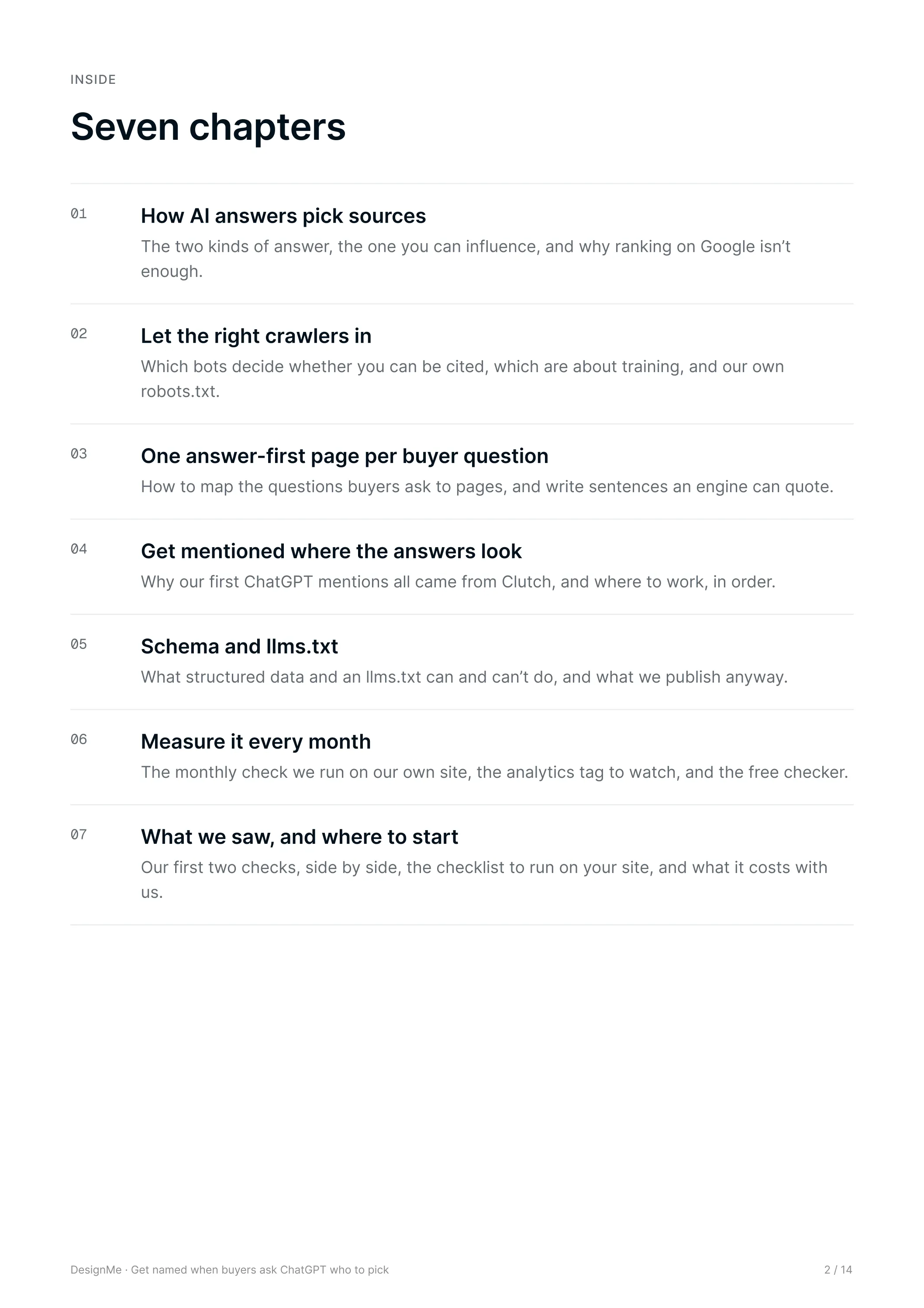 ContentsSeven chapters
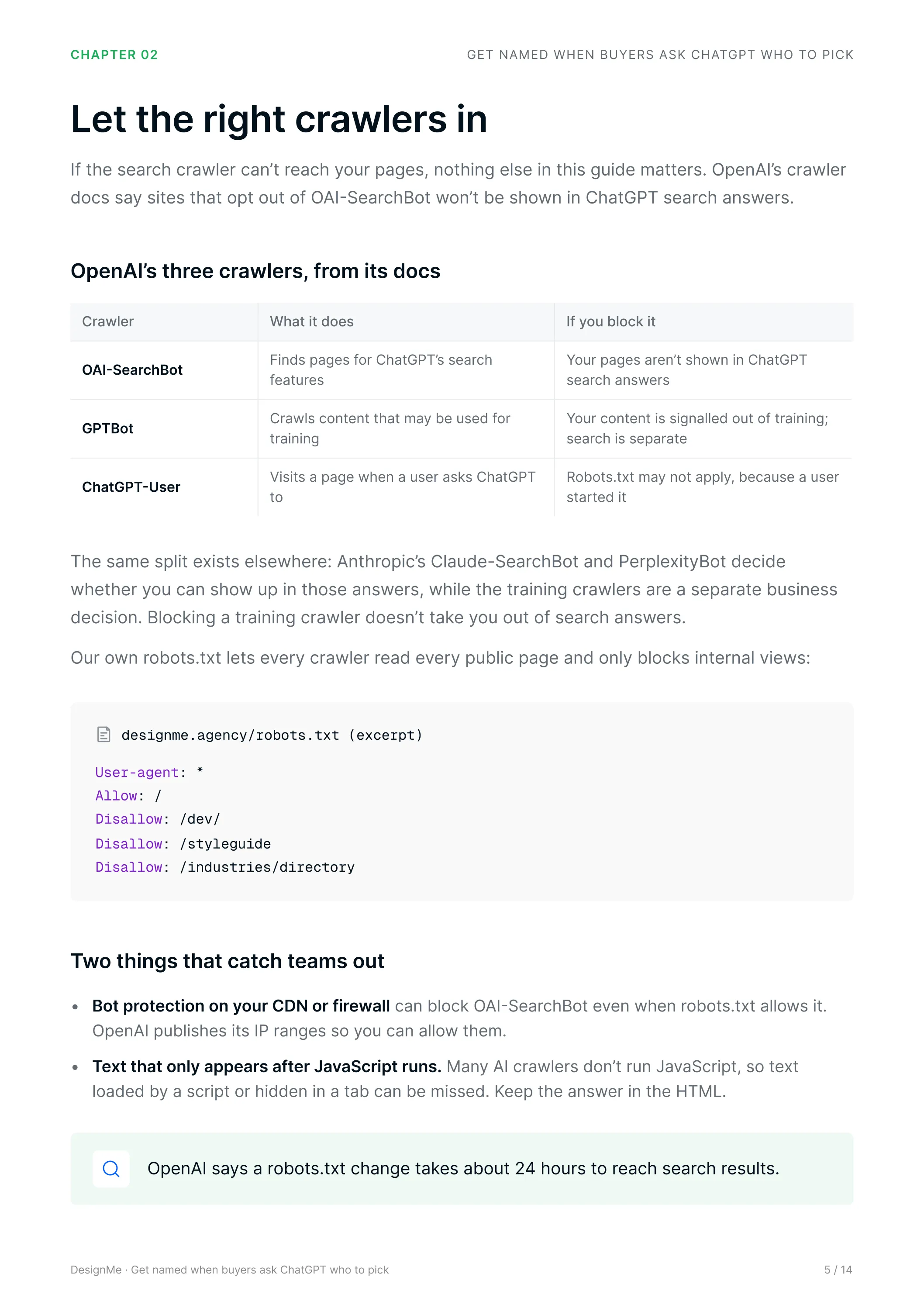 Chapter 2Let the right crawlers in
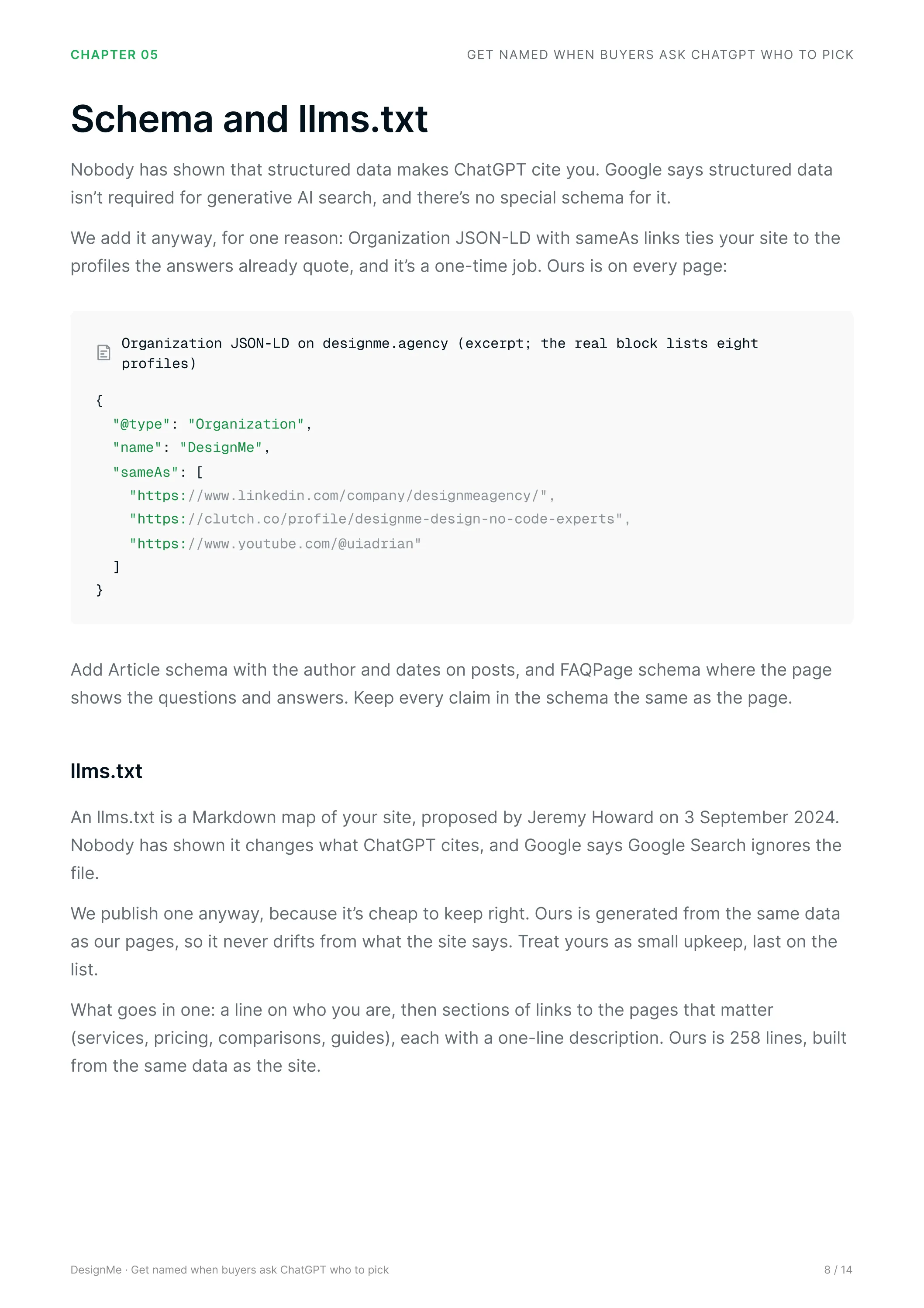 Chapter 5Schema and llms.txt
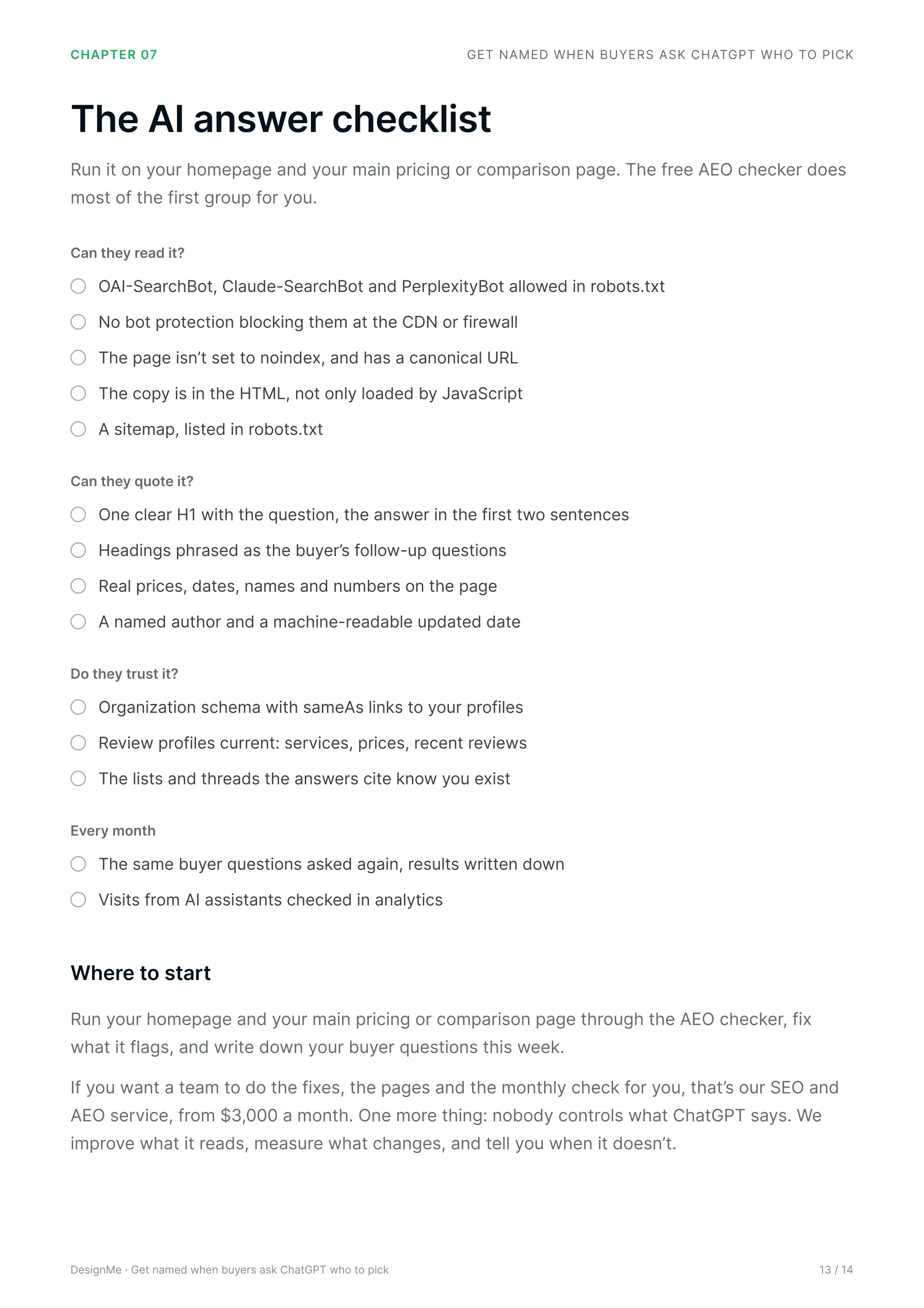 Chapter 7The AI answer checklist
Get named when buyers ask ChatGPT who to pick
Get the free guideIf you’d rather hand the work over, our SEO and AEO service covers the fixes, two new search pages a month and a ranking and AI citation report, from $3,000 a month.
Sources
- Google Search Central, AI features and your website (accessed 16 November 2026) (opens in a new tab)developers.google.com
- Google Search Central, Optimizing your website for generative AI features on Google Search (accessed 16 November 2026) (opens in a new tab)developers.google.com
- OpenAI, Overview of OpenAI crawlers (accessed 16 November 2026) (opens in a new tab)developers.openai.com
- Ahrefs, Top Brand Visibility Factors in ChatGPT, AI Mode, and AI Overviews (75k Brands Studied), 12 December 2025 (accessed 16 November 2026) (opens in a new tab)ahrefs.com
Press Escape to close.