How to Rank in ChatGPT: A Guide for SaaS Teams

Adrian KuleszoCo-founder
Table of contents
- How ChatGPT search picks and cites sources
- 1. Let the right crawlers in
- 2. Write one answer-first page per buyer question
- 3. Get mentioned where the answers look
- 4. Add schema that says who you are
- 5. Publish an llms.txt, and be honest about it
- 6. Measure it every month
- What we saw on our own site
- Where to start
- FAQs
To rank in ChatGPT, you need to be in the pages ChatGPT search finds and trusts when a buyer asks a question. Let OAI-SearchBot crawl your site, publish one answer-first page per buyer question, and get your company mentioned on the review sites, lists and forums the answers cite. Then ask your buyer questions every month and track who gets named.
Here’s what that looks like on our own site. On 3 October 2026 we asked ChatGPT ten questions our buyers ask. It named DesignMe in three answers, and all three cited our Clutch profile, not designme.agency. Claude and Perplexity named us once each. By 27 October, on a larger set of 35 questions, ChatGPT was citing one of our own pages in 9 answers and naming us in 4. Below is how ChatGPT picks its sources, the six things a SaaS team can do about it, and how to measure whether any of it worked.
- 3 of 10
- ChatGPT answers that named DesignMe, 3 October 2026
- 3 of 3
- of those answers cited our Clutch profile
- 0
- designme.agency pages among their sources
How ChatGPT search picks and cites sources
Here’s the short version. Some answers come from what the model learned in training, with no links. When a question needs current information, ChatGPT searches the web, reads a handful of pages and writes the answer from them, with links to the ones it used. Those cited pages are what you can influence.
Two kinds of answer
A buyer asks ChatGPT a question
From training
No links
Written from what the model learned. GPTBot is the crawler on this side.
From a live search
Links to the pages it used
Found by OAI-SearchBot. This is the side you can influence.
Block OAI-SearchBot and your pages are not shown in ChatGPT search answers
OpenAI runs a crawler for exactly this. Its crawler docs say OAI-SearchBot is used to surface websites in ChatGPT’s search features, and that sites opted out of it “will not be shown in ChatGPT search answers”. If OAI-SearchBot can’t reach your pages, nothing else in this guide matters.
What gets cited once the bot is in is less tidy. Ahrefs studied 75,000 brands across ChatGPT, Google’s AI Mode and AI Overviews (published 12 December 2025). Branded web mentions correlated with AI visibility at between 0.66 and 0.71, and YouTube mentions at about 0.74, while Domain Rating sat at 0.27 for ChatGPT. Ahrefs adds that correlation isn’t causation, which is fair. But the direction matches our own test: being talked about on other sites mattered more than how strong our own domain was.
It also matched a result I didn’t like. Our Framer vs WordPress post was the first organic Google result for “framer vs wordpress for startups” on 3 October 2026. ChatGPT answered the same question by citing Framer’s and WordPress’s own pages, and didn’t name us. Ranking on Google helps, but it doesn’t decide the citation on its own.
1. Let the right crawlers in
Three OpenAI user agents matter here, and they do different jobs. Here’s what each one does, from OpenAI’s crawler docs:
| Crawler | What it does | If you block it |
|---|---|---|
| OAI-SearchBot | Finds pages for ChatGPT’s search features | Your pages aren’t shown in ChatGPT search answers, though they can still appear as navigational links |
| GPTBot | Crawls content that may be used to train OpenAI’s models | Your content is signalled out of training; search is a separate setting |
| ChatGPT-User | Visits a page when a user asks ChatGPT or a Custom GPT to | Robots.txt rules may not apply, because the visit is user-initiated |
So allow OAI-SearchBot if you want to be cited. GPTBot is a separate business decision about training data, and blocking it doesn’t take you out of search answers. OpenAI says a robots.txt change takes about 24 hours to reach search results.
Our own robots.txt lets every crawler read every public page and blocks only internal views:
User-agent: *
Allow: /
Disallow: /dev/
Disallow: /styleguide
Disallow: /industries/directory
Two things catch teams out. Bot protection on a CDN or firewall can block OAI-SearchBot even when robots.txt allows it, which is why OpenAI publishes the IP ranges to allow. And pages that only render their text in the browser give a crawler less to read, so keep the answer in the HTML.
2. Write one answer-first page per buyer question
Here’s the method. Write down the questions your buyers ask before they buy, the ones a Series A founder would type into ChatGPT: “best SOC 2 tool for a startup”, “X vs Y for a sales team”, “how much does Z cost”. Map each question to one page on your site. If a question has no page, that’s your next page.
Then write each page so a sentence can be lifted as it is:
- Answer in the first two sentences. The question in the H1, the answer straight after it. This article opens that way.
- Use the buyer’s words in your headings. Phrase H2s as the follow-up questions they ask next.
- Put real specifics on the page. Prices, plan names, dates, customer names and numbers you can stand behind. “Affordable” gives an engine nothing to quote; “from $3,000 a month” does.
- Sign and date it. A named author and an updated date tell readers, and engines, the page is maintained.
Here’s the difference in one line. The first opening below is the kind of sentence an engine can’t use; the second is ours:
An opening, before and after
Before
“The all-in-one platform for modern teams.”
No category, no buyer, no price: nothing an engine can quote.
After
“DesignMe is a senior design and development team for funded SaaS and AI companies, from $6,000 a month.”
Category, buyer and price in one sentence that can be lifted as it is.
Comparison pages, pricing pages and “who is this for” pages are where this matters most, because they match the questions people ask right before they shortlist. Our AEO for SaaS guide goes deeper on writing them.
3. Get mentioned where the answers look
Here’s the part that’s easy to skip. ChatGPT answers about vendors lean heavily on what other sites say about you, and on our first check, on 3 October, every answer that named us cited our Clutch profile. That profile shows a 5.0 rating from 12 reviews. None of our own pages was a source in those three answers.
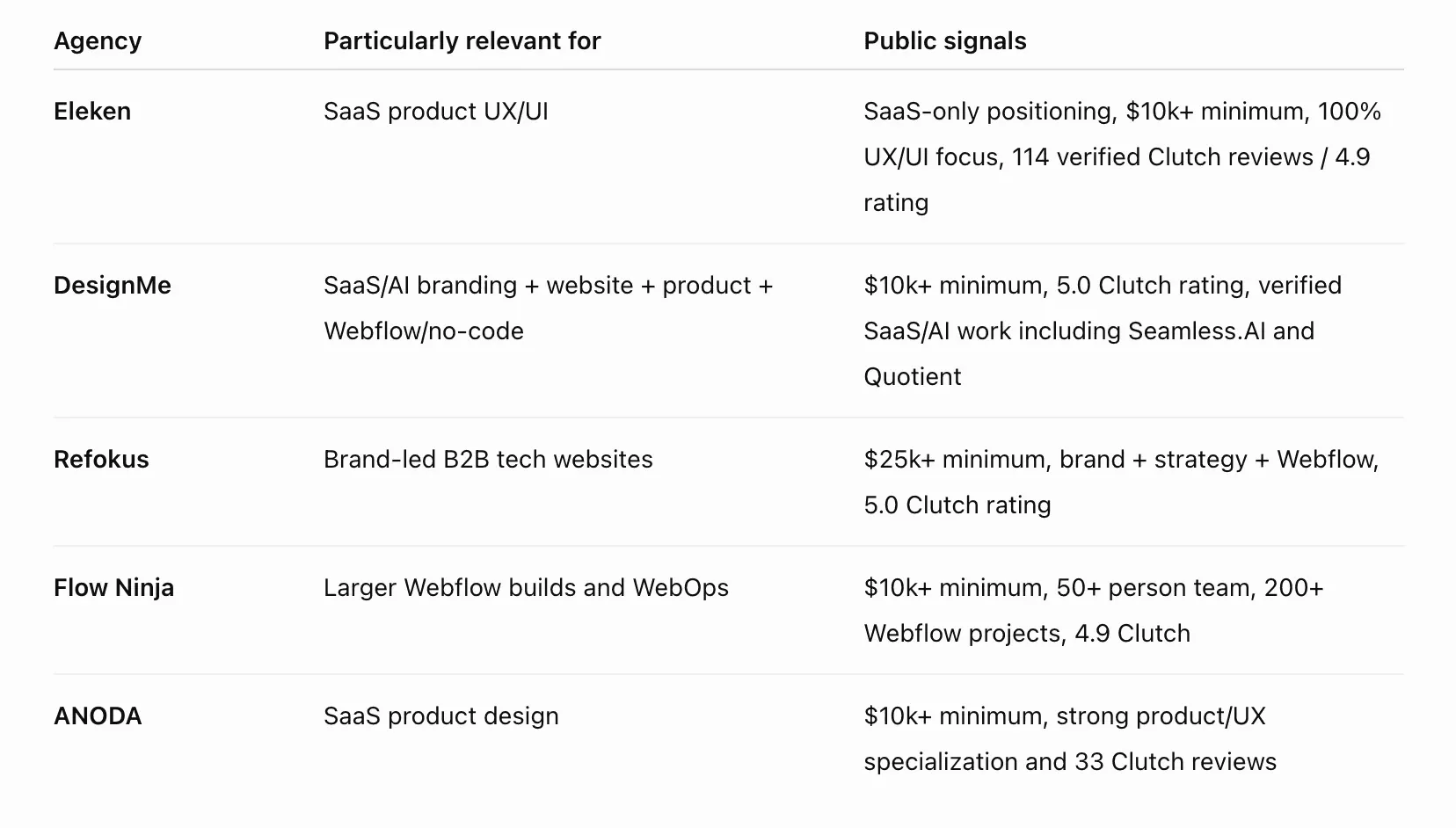
Where to work, in order:
- Review profiles. Clutch for services, G2 or Capterra for software. Keep the services, prices and screenshots current, and ask happy customers for a review after each project or renewal.
- “Best tools” lists. Find the listicles ChatGPT cites for your category, then ask the authors to consider you, with the facts that make the case. Don’t pay for a link to move rankings: Google treats that as link spam, and a paid placement should carry rel=“sponsored”.
- Reddit and communities. Answer questions in your category as yourself, say who you work for, and skip the pitch: communities remove promotional posts.
- LinkedIn and YouTube. Founder posts and product videos give engines more places that describe what you do. YouTube mentions had the strongest correlation in the Ahrefs study.
Before you start, ask your buyer questions and read the sources under each answer. If they already cite a review profile or a directory, fix that page first.
4. Add schema that says who you are
Nobody has shown that structured data makes ChatGPT cite you. Google is clear that “structured data isn’t required for generative AI search” and that there’s no special schema for it. Here’s why we add it anyway: Organization JSON-LD with sameAs links ties your site to the profiles answers already quote, and it’s a one-time job.
Ours is emitted once on every page by our base layout. The sameAs list links our LinkedIn, X, Dribbble, Clutch, Instagram, YouTube, Webflow and Framer profiles:
{
  "@type": "Organization",
  "name": "DesignMe",
  "sameAs": [
    "https://www.linkedin.com/company/designmeagency/",
    "https://clutch.co/profile/designme-design-no-code-experts",
    "https://www.youtube.com/@uiadrian"
  ]
}
That’s an excerpt; the real block lists all eight. Add Article schema with the author and dates on posts, and FAQPage schema where the page shows the questions and answers. Keep every claim in the schema the same as the page.
5. Publish an llms.txt, and be honest about it
An llms.txt is a Markdown map of your site. Jeremy Howard proposed it on 3 September 2024 as a way “to provide information to help agents use a website”. Here’s the honest part: nobody has shown it changes what ChatGPT cites. Google’s own guidance says creating one “will neither harm nor help your site’s visibility or rankings in Google Search, as Google Search ignores them.”
We publish one anyway, because it’s cheap to keep right. Our /llms.txt is generated from the same site data as our pages, so it never drifts from what the site says. Treat yours the same way: a small piece of upkeep, last on the list.
6. Measure it every month
Here’s the routine we use, and the one we run for clients on our SEO and AEO service:
The monthly ChatGPT check
Ask
The same ten buyer questions in ChatGPT, plus Claude, Perplexity and Google.
Record
Named or not, which pages are cited, and who shows up instead.
Check analytics
Sessions with utm_source=chatgpt.com, and the pages they land on.
Scan
Run the AEO checker on the pages you changed.
Fix
Pick the next pages and profiles to work on.
ChatGPT tags the links it sends with utm_source=chatgpt.com, so in GA4 those visits show up by session source. Our own scoreboard counted 122 visits from AI assistants in the 28 days to 3 November 2026, almost all of them from ChatGPT. It isn’t perfect: Search Engine Roundtable reported on 14 October 2026 that the tag had gone missing for about a week, with clicks landing in Direct, and on 15 October that it was a bug and the tag was back. If ChatGPT traffic drops to zero overnight, check the tag before you rewrite anything.
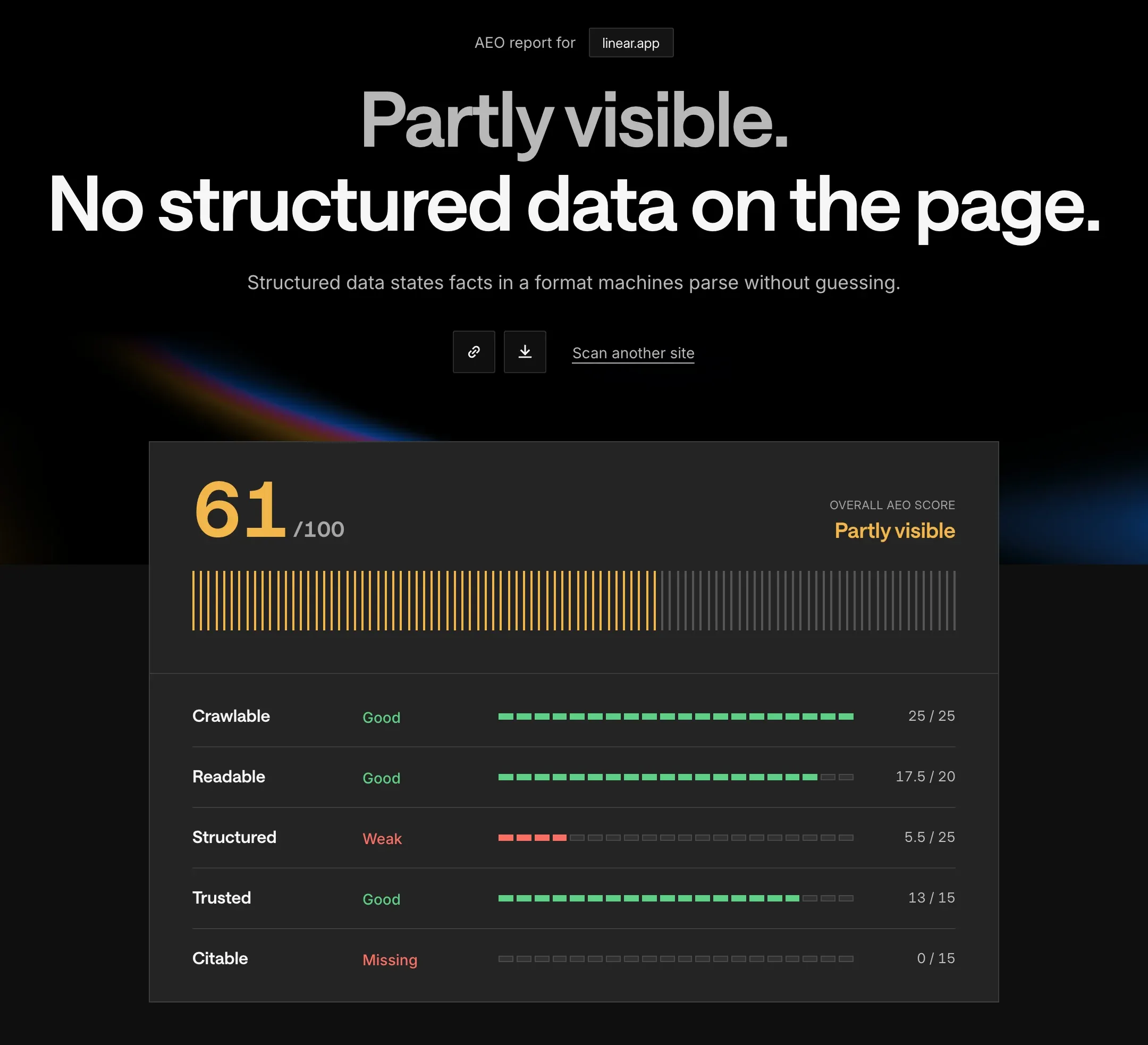
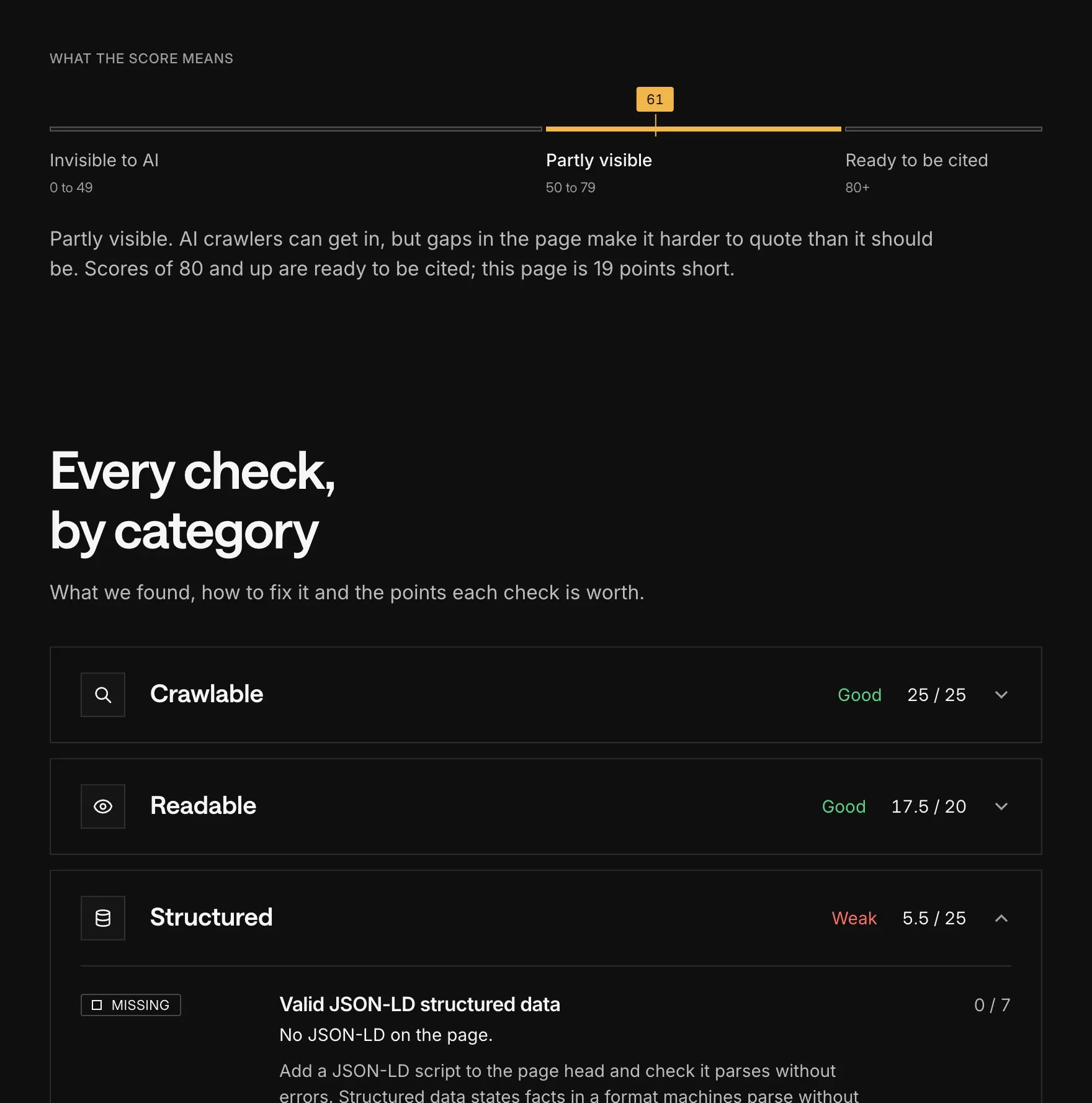
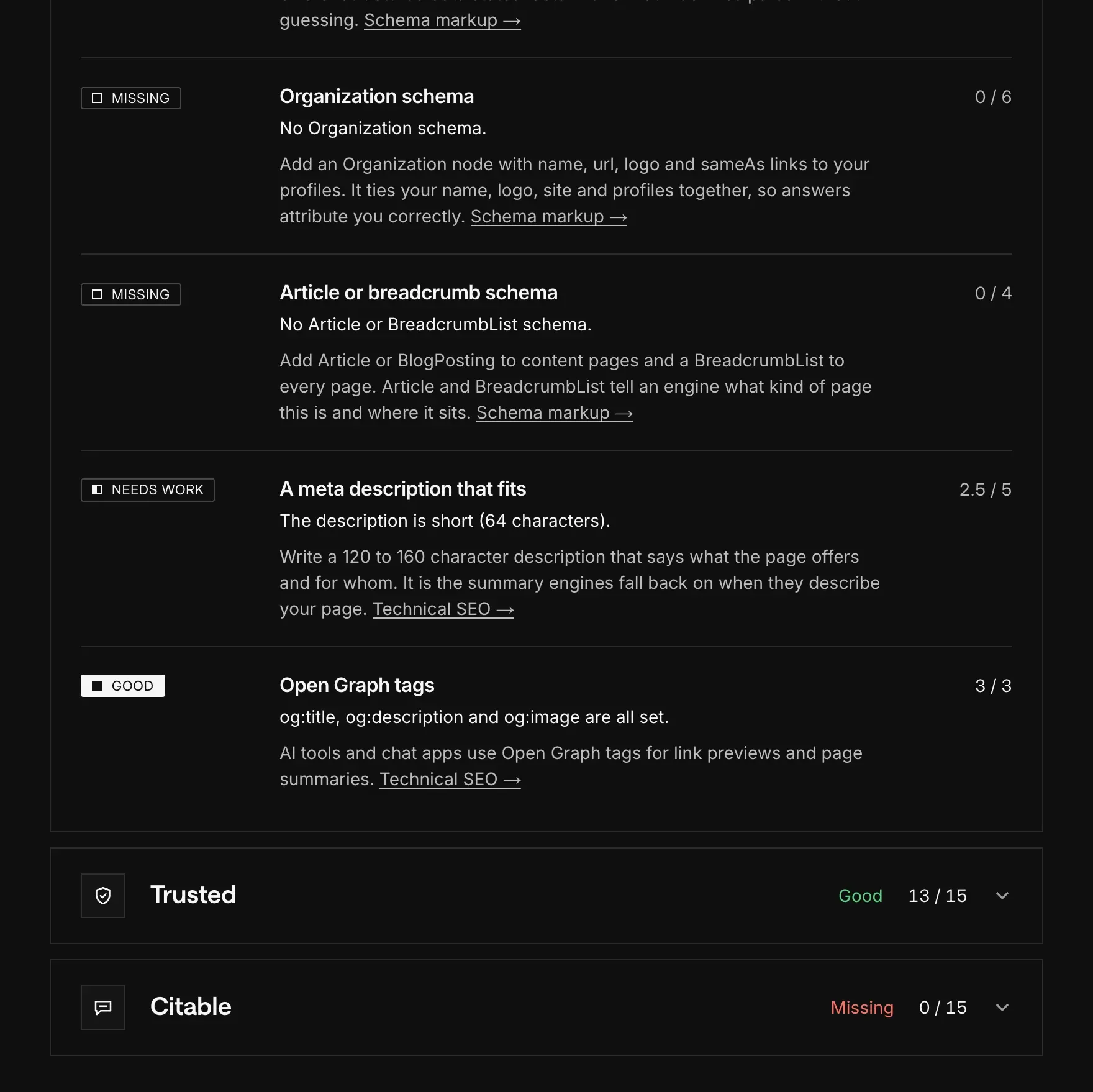
Between the monthly checks, our free AEO checker scores a page on crawler access, structure and the signals AI answers rely on, with a fix for each gap. Here’s a real report: Linear (linear.app), scanned on 18 October 2026, scored 61 out of 100. Crawlers get in and can read the page, but there’s no structured data and nothing an engine can quote as it is.
When you want every step of this article as one list, our free guide to getting named when buyers ask ChatGPT who to pick ends with a checklist to run on your homepage and your main pricing or comparison page.
A popular SaaS site, through our AEO checker
What we saw on our own site
Here’s our baseline from 3 October 2026: the same ten buyer questions on three assistants.
All three ChatGPT mentions cited our Clutch profile, and none cited a designme.agency page. Our first-place Google result for the Framer vs WordPress question didn’t earn a citation either. One mention each on Claude and Perplexity is too few to call a trend. What it did tell us is that the off-site work in step 3 matters as much as our own pages.
Here’s the next monthly check, on 27 October 2026. It’s a bigger set (35 buyer questions instead of ten) and partly different assistants (ChatGPT, Google AI Overviews and Gemini, tracked through Ahrefs Brand Radar), so read it as a new baseline, not a like-for-like trend.
This time ChatGPT cited one of our own pages in 9 answers and named us in 4. It uses our pages as a source before it recommends us, and the names came on narrow, specific questions. Google AI Overviews cited us in 9 and named us in 3, and Gemini quoted our guides 3 times without naming us. Across all three, 21 of 105 answers cite one of our pages and 7 name us. We can’t say which change did it, and the question sets differ, but our own pages now show up as sources, which they didn’t on 3 October.
Where to start
Run your homepage and your main pricing or comparison page through the AEO checker, fix what it flags, and write down your ten buyer questions this week. If you want a team to do the fixes, the pages and the monthly check for you, that’s our SEO and AEO service. For what that kind of help costs on the open market, see SaaS SEO agency: what to expect and pay.
DesignMe is a senior design and development team for funded SaaS and AI companies, with SEO and AEO as a monthly add-on. If you want to know whether ChatGPT names you today, send us your site and three buyer questions, and we’ll reply within one business day with what we found:
Sources
- OpenAI, "Overview of OpenAI crawlers" (checked 3 November 2026) (opens in a new tab)developers.openai.com
- Ahrefs, "Top Brand Visibility Factors in ChatGPT, AI Mode, and AI Overviews (75k Brands Studied)", 12 December 2025 (checked 3 November 2026) (opens in a new tab)ahrefs.com
- Google Search Central, "Optimizing your website for generative AI features on Google Search" (checked 3 November 2026) (opens in a new tab)developers.google.com
- Google Search Central, "AI features and your website" (checked 3 November 2026) (opens in a new tab)developers.google.com
- Google Search Central, "Spam policies for Google web search" (checked 3 November 2026) (opens in a new tab)developers.google.com
- llmstxt.org, "The /llms.txt file", Jeremy Howard, 3 September 2024 (checked 3 November 2026) (opens in a new tab)llmstxt.org
- Search Engine Roundtable, "OpenAI Drops UTM Parameters From ChatGPT Results (GPT-6)", Barry Schwartz, 14 October 2026, updated 15 October (checked 3 November 2026) (opens in a new tab)seroundtable.com
- Clutch, DesignMe profile (checked 3 November 2026) (opens in a new tab)clutch.co
Press Escape to close.